
Starting a family is a deeply personal journey. For some couples, it happens naturally. For others, it takes a little more help. That is completely okay.
IVF has helped millions of couples worldwide. It has turned heartbreak into hope. If you are exploring this option, you deserve clear answers. This guide explains everything simply.
What Is IVF Treatment?
IVF stands for In Vitro Fertilization. “In vitro” is a Latin phrase. It means “in glass.” Fertilization happens outside the body. Specifically, in a laboratory.
In a natural pregnancy, sperm meet the egg inside the fallopian tube. Fertilization happens there. The embryo then travels to the uterus. It implants and grows into a baby.
The fertilization procedure differs during IVF. Eggs are harvested from the female reproductive system, while sperm is extracted from the male reproductive system. Both the eggs and the sperm are then mixed together in a laboratory for fertilization.
IVF gives the process a helping hand. It bypasses obstacles that prevent natural conception. It is one of the most effective fertility treatments available today.
Who Needs IVF Treatment?
IVF is not the first step for everyone. Doctors usually recommend it when other treatments have not worked. But in some cases, IVF is the most suitable starting point.
You may need IVF if you have:
- Blocked or damaged fallopian tubes
- Severe male infertility or low sperm count
- Polycystic Ovary Syndrome that does not respond to medication
- Endometriosis affecting fertility
- Premature ovarian failure or poor egg reserve
- Unexplained infertility after one or more years of trying
- A genetic condition you do not want to pass on
- Previous failed fertility treatments, like IUI
Both partners are evaluated before IVF is recommended. Age, health history, and test results all play a role. You can get a customized consultation based on your needs and specific situation.
How Does IVF Work? The Step-by-Step Process
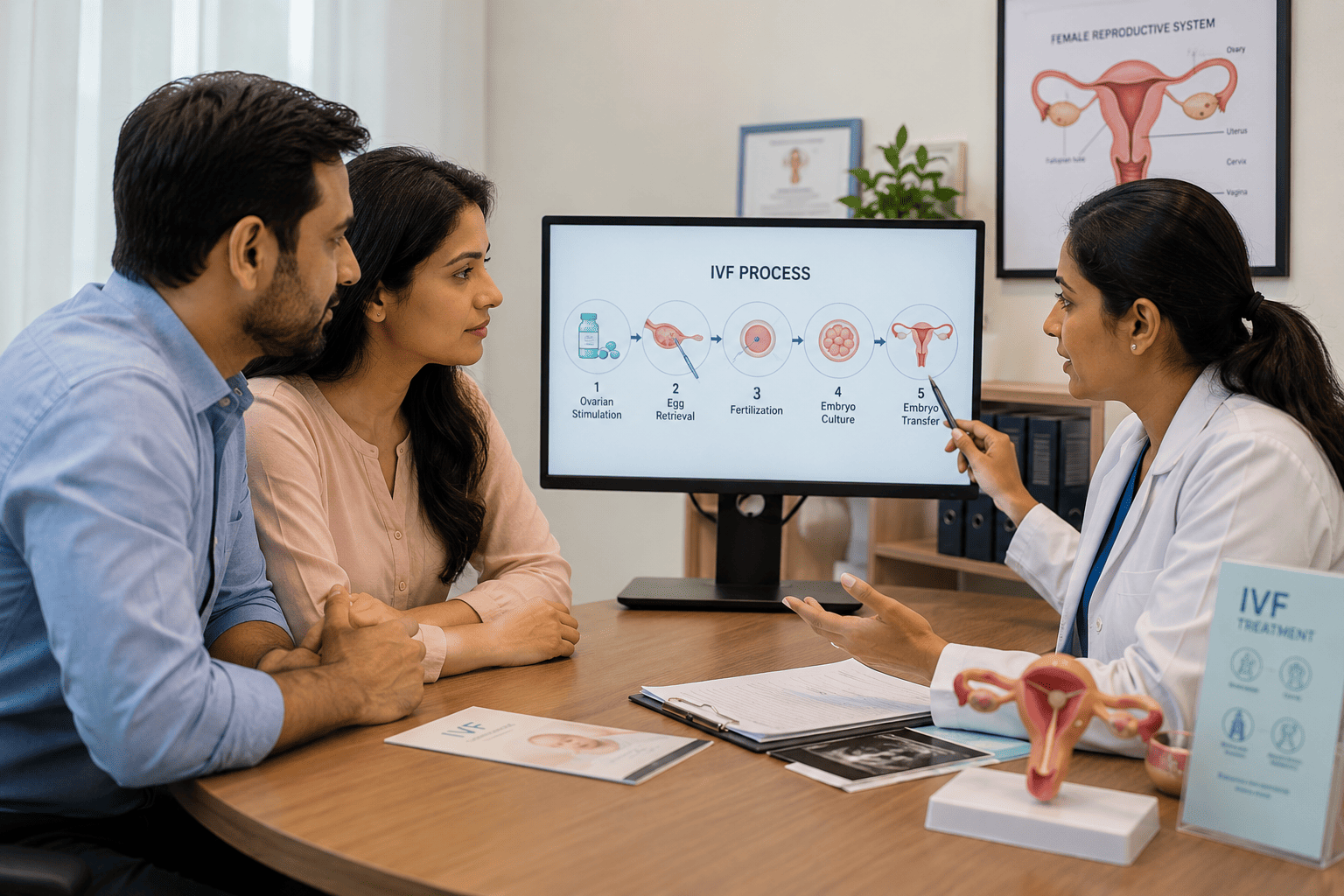
Understanding the IVF process makes it feel less overwhelming. There are five main stages. Each stage is carefully monitored by your medical team.
Step 1: Ovarian Stimulation
Under normal circumstances, one egg ripens each month. In IVF, more than one egg is required. With more eggs, the probability of fertilization success increases.
Hormone injections are given to the woman for 10 to 14 days. This induces the ovaries to produce several eggs. Ultrasound monitoring and blood tests are done regularly during this period.
Some women experience mild bloating or discomfort during this time. This is normal. Your team will carefully monitor any side effects.
Step 2: Egg Retrieval
Eggs are collected only when fully mature. This is called egg retrieval or egg pickup. It is a minor procedure done under light sedation.
Doctors carefully use a thin needle to pass it through the vaginal wall. It reaches the ovaries using ultrasound imaging. The process takes about 20 to 30 minutes. Most women feel mild cramping afterward. Rest is recommended for the remainder of that day. You will be completely okay within a day.
Step 3: Fertilization in the Lab
The retrieved eggs go to the embryology lab immediately. Doctors generally collect the semen samples from the male partner on the same day. Donor sperm can also be used if needed.
The embryologist prepares the sperm. Healthy sperm are selected carefully. Fertilization then happens in one of two ways.
- Conventional IVF: Sperm and eggs are placed together. Sperm fertilizes the egg naturally in the lab environment.
- ICSI (Intracytoplasmic Sperm Injection): A single healthy sperm is injected directly into each egg. This is used when sperm quality is low.
Fertilized eggs become embryos. They are monitored over the next three to five days. The embryologist tracks their growth and quality at every stage.
Step 4: Embryo Transfer
The best quality embryo is selected. It is transferred into the woman’s uterus. This is usually done on Day 3 or Day 5 after fertilization.
Day 5 embryos are called blastocysts. They have a higher chance of successful implantation. Your doctor will recommend the best timing for your situation. The transfer procedure is simple. No anesthesia is usually needed. A thin catheter carries the embryo through the cervix into the uterus. It takes only a few minutes. Most women feel little to no discomfort.
After the transfer, rest is advised. Light activity is generally fine. You will be given progesterone support to help with implantation.
Step 5: The Two-Week Wait and Pregnancy Test
This is often the hardest part. After the embryo transfer, you wait. A blood test is done approximately 14 days later.
This test checks for the pregnancy hormone hCG in your blood. A positive result means the embryo has implanted successfully. A negative result does not mean IVF has failed permanently. Many couples succeed on their second or third attempt.
Doctors first review your results, then tell you what the next step is. These common steps give you a clear idea of how IVF works.
IVF Process in India: What to Expect
IVF in India is widely accessible and well-regulated. The quality of care at leading clinics meets global standards. India has become a trusted destination for fertility treatment.
The IVF procedure in India follows the same pattern discussed earlier. The procedure is customized for individual couples. Highly advanced laboratories and skilled embryologists have made tremendous success possible.
In addition, treatment in India is much more affordable compared to the West. This ensures that many couples can access quality fertility services. The entire IVF process in India, from start to test, takes approximately four to six weeks. Some couples may need more than one cycle. Your doctor will give you a realistic picture upfront.
IVF Success Rate in Bangalore
Success rates vary. They depend on several important factors.
Factors that affect IVF success include:
- Age of the woman: Younger women tend to have greater success. The under-35 age group has the highest success rate.
- Quality of egg and sperm: Healthy eggs and sperm result in good embryos.
- Healthy uterus: A healthy uterine environment is conducive to implantation.
- Embryologist skills and laboratory facilities: Embryologists play a significant role in the process of embryo formation.
- Number of embryos transferred: More healthy embryos increase the success rate.
In Bangalore, top fertility clinics report success rates between 40% and 60% per cycle for women under 35. Rates decrease gradually with age. Your doctor will give you personalized success expectations based on your reports.
Do not rely solely on statistics. Every couple’s case is unique. A good specialist will honestly assess your specific situation.
Is IVF Painful or Risky?
This is one of the most common concerns couples have. IVF is generally well-tolerated. The hormone injections can cause mild discomfort. Some women experience bloating, mood swings, or fatigue during stimulation. These are temporary.
A rare complication is Ovarian Hyperstimulation Syndrome or OHSS. This happens when the ovaries respond too strongly to medication. Mild OHSS resolves on its own. Severe cases are rare and are managed medically.
You will get a minimally invasive surgery option for egg retrieval and replacement of the embryo. Most women manage them with little difficulty. Your medical team will monitor you throughout. Safety is always the first priority.
Emotional Support Matters During IVF
IVF is not just a physical journey. It is an emotional one, too. The waiting, the uncertainty, and the hope can feel overwhelming.
Talk to your partner openly. Seek support from trusted friends or a counselor. Many fertility clinics offer emotional support as part of their care. You do not have to carry this alone. Treat yourself well as you go through this process because every step is progress.
First Step Towards Building Your Family
You deserve answers and to be treated with compassion. Many people have already achieved their dream of having babies through IVF procedures. At SK Women’s Clinic, fertility care is personalized, transparent, and supportive from day one. Every couple receives individual attention. Every concern is taken seriously.
If you are ready to explore your options, speak with an experienced IVF specialist in Bangalore at SK Women’s Clinic today. Your journey to parenthood starts with one conversation. Book your consultation now.